

The Path Forward
Where the Election Truth Alliance case stands in Pennsylvania

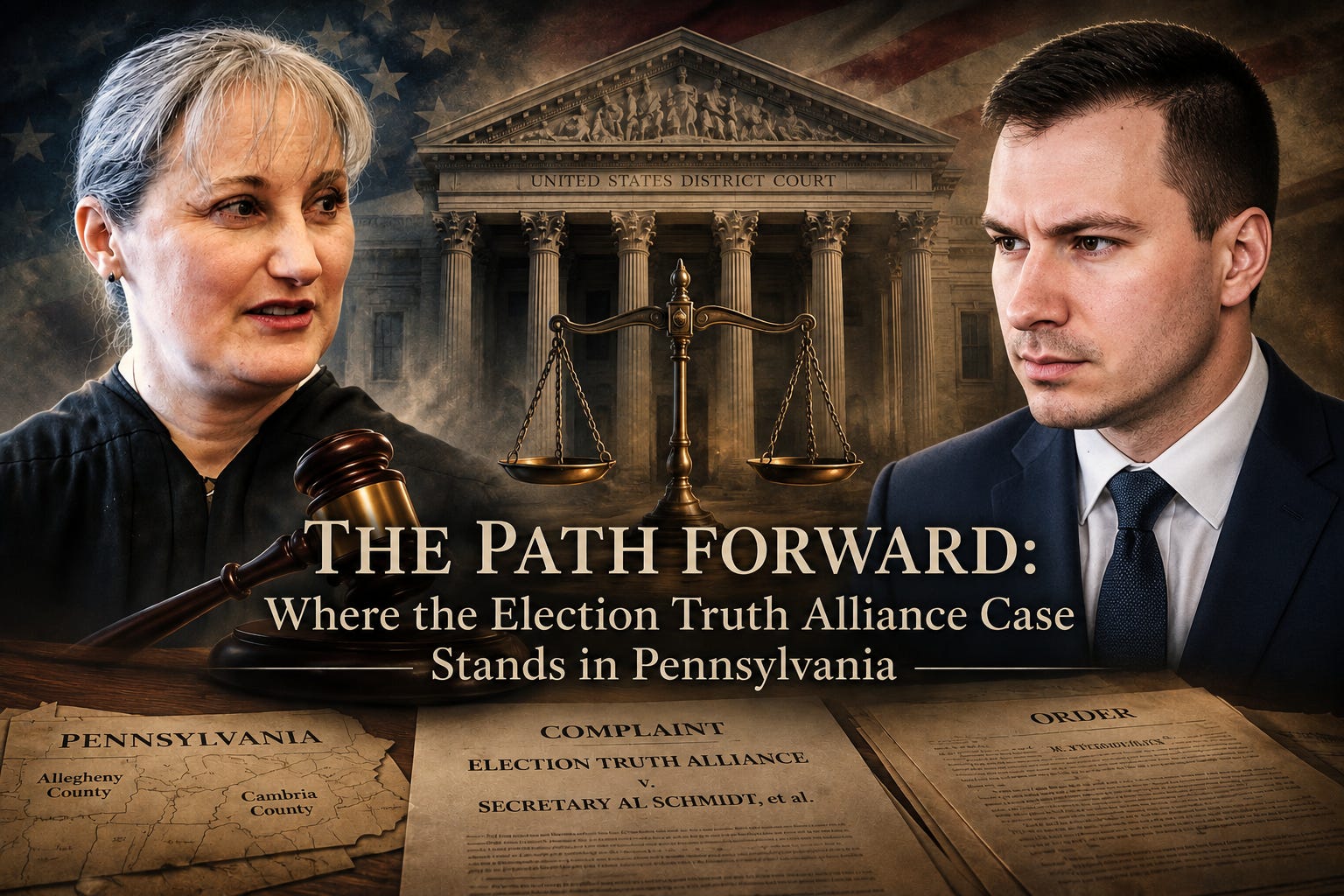
When news broke that Federal Judge Susan Paradise Baxter had dismissed the Election Truth Alliance’s lawsuit in Pennsylvania (wherein the ETA was challenging aspects of Pennsylvania’s 2024 election results), supporters of the ETA immediately became deflated.
Proponents of the Trump regime proclaimed that the court had debunked the ETA’s allegations, while the skeptics who are criticizing the validity of the 2024 election insisted that the judge refused to look at the evidence.
Well, one of those interpretations is pretty darned correct, and I’ll give you until the end of this article to decide which one.
The Court Never Reached the Central Question
Some people naturally assume that the judge reviewed the Election Truth Alliance’s evidence and concluded that the election results were accurate.
That, my friends, is not what happened.
In her June 12, 2026 Memorandum Opinion, Judge Baxter focused primarily on a threshold legal issue known as standing. In federal court, before a judge can consider whether a claim is true or false, the plaintiffs must first establish that they have suffered a legally recognizable injury and that the court has the authority to remedy it.
The court concluded that the ETA failed to satisfy those requirements.
As a result, the judge never proceeded to determine whether the alleged election irregularities occurred.
What Is Standing?
Standing is one of those legal terms we’ve heard a lot around allegations of voter fraud in the United States. Yet, it remains one of the most misunderstood concepts in American law.
A plaintiff cannot simply point to something they believe to be unlawful and demand a judicial investigation.
Instead, they must demonstrate three things:
They suffered a concrete and particularized injury.
The injury was caused by the defendants.
A favourable court ruling would likely remedy that injury.
Judge Baxter found that the ETA’s plaintiffs failed to establish all three elements.
The plaintiffs alleged that voting machines and tabulation systems in several Pennsylvania counties may have produced inaccurate results.
However, the court noted that none of the individual plaintiffs identified a specific ballot that was miscounted, a specific vote that was lost, or a specific tabulation error that affected them personally.
The court therefore viewed the alleged injury as too generalized to support standing in federal court.
What Did the Court Permanently Dismiss?
This is where the ruling becomes significant.
Judge Baxter dismissed all claims seeking retrospective relief concerning the 2024 election with prejudice.
In plain English, that means those claims are finished in this federal case.
The court ruled that the ETA can no longer use this lawsuit to seek:
A recount of the 2024 election.
A forensic audit of the certified results.
A judicial determination that the certified vote totals were inaccurate.
Any order that would alter or disturb the certified results.
The judge reasoned that the election has already been certified, public officials have taken office, and government has been operating under those results for many months.
On Page 13 of her opinion, Judge Baxter wrote, “…the results of the 2024 General Election have been certified by the Commonwealth of Pennsylvania, and the winning candidates have assumed office. An order directing a recount or forensic audit could not, as a practical matter, alter the certified results or the composition of the government formed based on those results. The retrospective claims are therefore moot.”
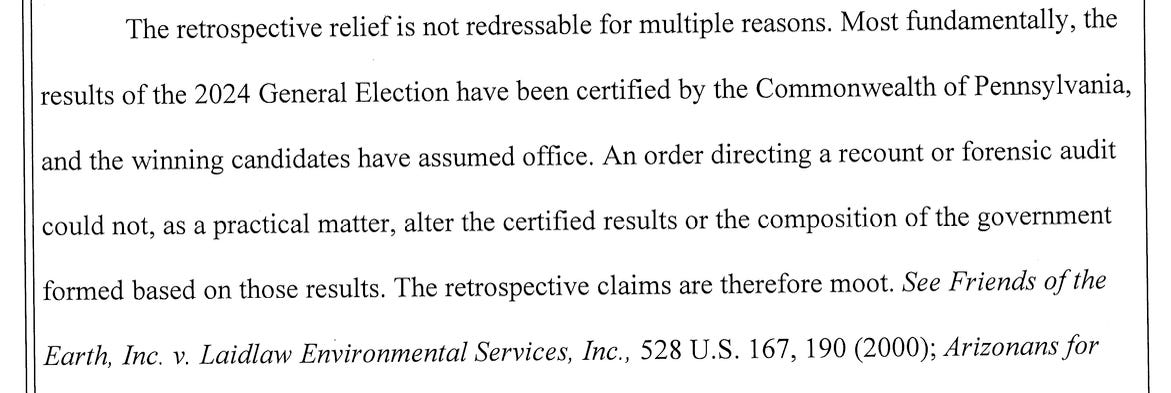
In so many words, Judge Baxter is saying that, if the Trump campaign did cheat in the 2024 election, then they got away with it… so there’s nothing anyone can do about it now. You may have evidence of widespread vote manipulation, but, until you have evidence of specific vote manipulation (ie. a particular ballot that was tampered with), then the court won’t even look at any of that other evidence.
What Survived?
This is the part of the ruling that many headlines overlooked, and perhaps for good reason.
Judge Baxter did not completely close the door on the case.
Instead, she dismissed the ETA’s claims relating to future elections without prejudice and granted the plaintiffs thirty days to file another amended complaint.
In legal terms, “without prejudice” means the plaintiffs are being given another opportunity to try again.
However, the court imposed strict conditions.
Any amended complaint must specifically identify:
Future elections in which the plaintiffs intend to vote.
A credible threat that the alleged problems will recur.
A direct connection between the alleged future harm and the conduct of the named defendants.
This is not a simple technical correction.
It requires the ETA to fundamentally reshape portions of its case. Beyond that, it is essentially asking the ETA to do the impossible. That is to say, it would be impossible if Judge Baxter held the ETA to the same high bar to which she has held them up to this point, which is to essentially say, “Prove that the Trump campaign cheated, show me how they did it, and bring me some witnesses who can testify about their participation in efforts to manipulate the results of the 2024 election. Oh, and while you’re at it, prove that they altered a particular person’s vote who happens to be standing in the court room right now.”
Nonetheless, this faint hope means that a final ruling in the case has not yet been made, and that has implications on the ETA’s ability to appeal because higher courts are loathed to hear appeals on cases where a final judgment has not yet been rendered.
Why the Court Focused on Future Harm
Federal courts are generally reluctant to issue advisory opinions.
A plaintiff must show not only that something happened in the past, but that a court order could prevent a future injury.
Judge Baxter concluded that the ETA had not adequately shown that any named plaintiff faced a concrete future injury that the court could address. (Remember the requirement to show that a particular ballot was tampered with?)
The judge nevertheless suggested that such a claim might be possible if pleaded with greater factual specificity.
In so doing, Judge Baxter invariably reminds us of bugs that we all tend to encounter in apps or websites from time to time. You might, for example, not be able to sign into a website, so you enter your email address to allow you to reset your password, but then you are told that your email address has never been registered, so then you try to register, and then you’re told you can’t because that same email address is already in use. There you are, stuck in a loop.
In this case, the ETA can show the court a plethora of evidence supporting the existence of widespread election manipulation in the 2024 election, but the court won’t look at it unless the ETA can first prove that a particular individual’s vote was manipulated. They can show that thousands of votes for Trump just magically appeared out of nowhere, but unless the ETA can somehow prove that a particular individual’s vote was changed, and that this will likely happen again, then the court will not even examine the evidence that the ETA has brought.
The Catch 22
The ETA is asking the court to grant access to evidence that they believe may reveal election inaccuracies. The court, however, is requiring a more concrete showing of injury and causation before granting access to that evidence. Thus, the ETA needs the investigation in order to obtain the very evidence that the court says is missing.
You can probably imagine how absurd this would all sound if we were talking about a bank robbery where there is plenty of evidence suggesting that the robbery took place and the money is now hidden under the floorboards of the suspect’s house, but the plaintiff can’t even get a search warrant unless they can first produce a customer who can prove that their money, in particular, was stolen by the bank robber. Otherwise, sorry… no search warrant for you!
Apparently, the prospect of the entire US election system being systematically rigged by the most powerful men in the world just isn’t serious enough to warrant any latitude by Judge Baxter.
What About Pennsylvania Election Law Claims?
Another important aspect of the ruling received little attention.
The ETA asserted claims under Pennsylvania’s Election Code.
The court did not reject those claims on their merits.
Instead, after dismissing the federal claims, Judge Baxter declined to exercise jurisdiction over the remaining state-law issues.
Those claims were dismissed without prejudice.
That means the ETA remains free to pursue them in an appropriate Pennsylvania state court.
What were those claims?
The ETA asserted several claims under Pennsylvania’s Election Code in addition to its federal constitutional claims. According to the complaint, the ETA alleged that election officials failed to comply with statutory requirements governing the administration of elections, including provisions relating to voting-system certification, testing and auditing procedures, chain-of-custody safeguards, and the handling and tabulation of ballots.
The ETA argued that these alleged violations were significant because Pennsylvania’s Election Code establishes detailed procedures intended to ensure election integrity and public confidence in election outcomes. The organization contended that election officials either failed to follow certain mandatory requirements or relied on practices that were inconsistent with the Code’s safeguards.
Judge Baxter did not decide whether any of those allegations were correct.
The court did not rule that Pennsylvania election officials complied with the Election Code, nor did it rule that they violated it.
Instead, after dismissing the federal claims that formed the basis for federal jurisdiction, Judge Baxter declined to exercise supplemental jurisdiction over the remaining state-law claims.
Federal courts often take this approach when all federal claims have been dismissed before trial. Rather than deciding unresolved questions of state law, the federal court leaves those issues for state courts to address.
As a result, the ETA’s Pennsylvania Election Code claims were dismissed without prejudice.
That means the ETA remains free to pursue those claims in an appropriate Pennsylvania state court, where the merits of the alleged Election Code violations could be litigated directly.
Again, sounds like Judge Baxter left the ETA with some faint hope, right?
Maybe.
Maybe not.
What Options Does ETA Have Now?
At this point, the ETA appears to have three primary options.
Option One: File Another Amended Complaint
The court has provided a thirty-day window to submit a revised pleading focused on future elections.
To succeed, the ETA would need to provide much more specific allegations regarding future injury, future elections, and causation.
Option Two: Appeal
The ETA may seek review by the United States Court of Appeals for the Third Circuit.
An appeal would likely focus on whether Judge Baxter applied standing doctrine too narrowly and whether the plaintiffs’ allegations should have been sufficient to allow the case to proceed.
Option Three: Proceed in Pennsylvania State Court
Because the state-law claims were dismissed without prejudice, the ETA may attempt to pursue Pennsylvania Election Code claims in state court rather than federal court.
Whether that strategy could possibly prove to be successful remains to be seen.
The Bottom Line
The most important takeaway from Judge Baxter’s ruling is that it was largely procedural rather than factual.
The court did not determine whether the Election Truth Alliance’s allegations were true. Nor did it determine that they were false.
Instead, the court concluded that the plaintiffs, as presently pleaded, lacked the standing necessary to litigate those claims in federal court.
As a result, the door has been permanently closed on efforts within this case to challenge the certified results of the 2024 election in Pennsylvania.
Yes, a narrower door remains open. However, I might describe it as a window. To be more precise, I might describe it as window dressing.
The ETA may still attempt to amend its complaint regarding future elections, appeal the standing ruling, pursue state-law claims in Pennsylvania courts, or some combination of all three.
However, by my reading of the ruling and the circumstances surrounding the case, Judge Baxter – a trump appointed judge – is merely seeking to burn up precious time for the Election Truth Alliance to launch an appeal to a higher court by refusing to issue a complete and final ruling in this case. By leaving faint hope to resubmit an amended complaint within 30 days, Baxter is essentially toying with the ETA, enticing them to burn up more time and more money fighting a case that they could not possibly win in Judge Baxter’s court…
because, by my reading of the situation, Judge Baxter is apparently unable to see the forest for the trees.
Please follow and support the work of the Election Truth Alliance, SMART Elections, and This Will Hold.
From wow 🤯 to whoa 😳 to wait, what? 🤨 to:
Ohhhh, a pseudo Aileen Canon kinda delay delay delay 🛑
Standing: Yup. That's one the the doctrines used to dismiss the Trump suits in '20. Laches was another ("you shoild have brought this up earlier"). Laches is out of common law. Carrie Lake got both Laches and ripeness ("naah, it's too soon to do this one"). Dont know what ripeness derives from. Not sure about standing either. Not a fan of standing as a concept. Not a fan of how they all are used to fuck plaintiffs and keep evidence from being heard.